

Key Takeaways
- A split mechanical seal consists of two separate halves, which means technicians can easily install it around a shaft without disassembling rotating equipment.
- Because the rotating equipment remains assembled, replacing a split seal takes minutes, rather than hours or even days, which reduces downtime and maintenance costs.
- Split seals are a more affordable and effective sealing option for large pumps, mixers, and agitators than traditional mechanical seals. However, they are not suitable for applications with toxic or flammable fluids, since split seals naturally have more potential leak paths than solid seals.
- Split seals have a wide range of applications and are found in many types of facilities, including power plants, wastewater treatment facilities, paper mills, and desalination plants.
- Flexaseal’s patented Style 85 is the leading two-piece split cartridge mechanical seal. It retains the seal faces, O-rings, and other components together inside two cartridge halves so they can’t be damaged or misplaced during installation.
Replacing a mechanical seal is rarely as simple as sliding a new one onto the shaft. Because traditional one-piece seals have to travel over the end of the shaft to reach the seal chamber, replacing one often requires uncoupling the motor and tearing down the pump. On large rotating equipment, this process can keep a critical asset offline for days.
A split mechanical seal eliminates the need for disassembly. Because a split seal consists of two or more pieces that fit together around the shaft, a technician can install it with the unitized pump, mixer, or agitator still in place, reducing work from hours or days to minutes.
What Is a Split Mechanical Seal?
A split mechanical seal, also known as a split seal, is a mechanical seal that consists of two separate halves (though some split seals feature four chief components or more). This design enables a technician to install it around a shaft with no equipment disassembly required. A complete split seal assembly can be fitted to rotating equipment, such as a pump, mixer, or agitator, while the machine remains fully intact.
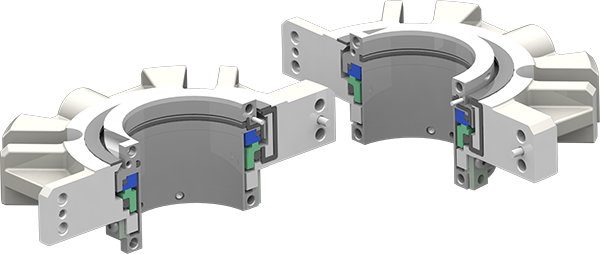
Mechanical seals, split or not, close off the point where a rotating shaft passes through the equipment housing by pressing two precision-lapped faces together. One of these faces rotates with the shaft, while the other remains fixed in the gland, which prevents process fluid from escaping as the shaft turns.
Traditional mechanical seals are a solid unit. The only way to get it onto the equipment is to slide it over the end of the shaft, which typically requires uncoupling the driver and at least a partial teardown of the pump.
Split seals remove that constraint, making it easy for a technician to assemble the seal around the shaft and install onto the fully-assembled rotating equipment.
How Does a Split Mechanical Seal Work?
Once the two halves of a split seal are fastened together around the shaft and fixed to the equipment, the assembled seal operates as any other cartridge mechanical seal does: A rotating face and a stationary face press together and ride on a thin film of fluid, containing the process while the shaft spins.
The Two-Piece Design
In a fully split seal, both components are divided along the same plane. Each half houses a portion of the lapped seal faces and secondary seals. Elastomeric gasket elements close off the static joints created by the split, and the gland hardware and integral assembly pins keep every piece aligned once the halves come together.
The materials of the split faces are critical to their performance. Tungsten carbide, for example, is a tough and resilient seal face material commonly applied in many solid mechanical seal applications; however, it is not a suitable material for a split seal because it does not form a suitable interface for joining back together after it is split.
Many split seals pair carbon primary rings against silicon carbide mating rings in non-abrasive applications, and the elastomers, which must be custom-molded to seal the split joints, are typically made from FKM, TFE/P, or EPDM.
Flexaseal’s Style 85 two-piece split cartridge design dramatically improves ease of installation. Four-piece component-style versions involve numerous loose parts, and installing them often requires precise measurements, shims, and specialized tooling. The two-piece split cartridge design is self-aligning, which eliminates a common leak path present in the four-piece component designs.
How to Install a Split Seal
While the exact procedure may vary by manufacturer, a Flexaseal Style 85 two-piece split cartridge seal installation looks like this:
1. Perform all necessary safety steps to work on the equipment. This generally starts with locking out the equipment and relieving the system pressure. With the equipment drained, clean the shaft in the area where you will mount the seal.
2. Remove the old packing or failed seal, clearing out any debris left behind in the stuffing box.
3. Ensure that the surface of the pump shaft or pump shaft sleeve that would be under the seal sleeve is in good condition, and does not have any scoring or burrs that could create a secondary leak path.
4. Lightly lubricate the inside diameter of the seal sleeve O-ring, taking care not to get any lubricant on either the cut faces of the O-ring(s) or seal faces.
5. Place both seal halves around the exposed shaft, positioning them so that the split joints cleanly meet.
6. Bolt the halves together, evenly following the recommended torque specified in the seal IOM and slide the seal into the seal chamber.
7. Fix the gland studs to the equipment (if they are not already installed), and tighten the gland nuts on the studs to the recommended torque value in the IOM.
Caution: Overtightening at this point has the potential to induce a leak path by inadvertently re-opening the split halves, even slightly. Take care to only tighten the gland nuts to the recommended torque for the seal.
8. Tighten the seal sleeve set screws to the shaft to their recommended torque values.
9. Remove the seal setting clips (only after the set screws have been verified to be fixed in place).
10. Assemble any seal support plan piping that may be specified. These are commonly API Seal Plans 11, 13, or 32, although others are possible. This completes the seal assembly.
11. Replace any guards, and return the equipment to service. Occasionally, a slight weepage may occur on initial startup, which typically runs in and resolves over time
What Are the Benefits of Two-Piece Split Cartridge Mechanical Seals?
Two-piece split cartridge mechanical seals save time and money by enabling maintenance crews to replace seals without having to tear down equipment. Key benefits for split seals include:
- Reduced downtime: Replacing a conventional seal on a large pump can keep equipment offline for minimally hours and sometimes days, with much of that time being spent on teardown and reassembly rather than actual seal work. A split seal helps avoid all of this, and one or two technicians can finish the whole job in minutes instead of hours or days, preventing lost production and uptime.
- Fewer installation errors: Because installing a two-piece split cartridge seal involves fewer steps with less individual components, it creates fewer chances for the kind of installation errors, such as damaged faces, incorrect setting dimensions, or pitched or rolled elastomers, that can reduce a seal’s life in service.
- Consistent performance: Split seals can deliver the same performance as their conventional one-piece counterparts in terms of pressure, temperature, shaft speed, durability, and longevity.
- Less upkeep than packing: Packing used to be the only option for equipment that couldn’t be torn down for seal service. The difficulty with packing is that it requires frequent adjustments or replacement and must leak a small amount to remain properly lubricated. Over time, the equipment shaft sleeve will require replacement as well, which necessitates a complete equipment teardown. Split mechanical seals eliminate the need for packing (and use zero or significantly less flush water). Most split seals mount outside the stuffing box and can be installed on the undamaged part of the existing sleeve, so you can replace packing with a split seal without having to replace the worn shaft sleeve.
- Lower costs: Although the initial purchase price of a split seal is often higher than that of a traditional seal or packing, the life-cycle costs are lower than either option when considering maintenance interventions and downtime. Replacing a one-piece seal, especially on large equipment, can take an entire crew multiple days, which adds to labor costs and lost value due to production downtime. A split seal avoids these expenses, and since the equipment never moves, there’s no need for realignment work afterward.
When to Choose a Split Mechanical Seal vs. a Conventional Mechanical Seal
Whether you choose a split seal or a traditional seal depends on how difficult it is to reach the seal on your equipment, what material you’re working with, and cost.
| Split Mechanical Seal | Conventional Mechanical Seal | |
| Best Fit | Equipment that takes considerable time and efforts to disassemble (e.g., pumps and mixers with large shaft sizes, vertical shaft pumps, side-entry mixers and agitators, double-suction pumps) | Smaller pumps that are relatively easy to open up and work on. |
| Fluid Compatibility | Water and other non-hazardous fluids | All fluids |
| Replacement Downtime | Minutes | Hours or Days |
| Cost | Lower life-cycle cost | Lower upfront price, but costs vary by pump size; economical choice for smaller pumps, but could lead to higher lifetime cost for larger pumps |
See How the Flexaseal Style 85 Stacks up to the Chesterton 442C™>>
Common Applications for Split Mechanical Seals
Split seals are commonly used on large pumps and mixers that handle water-based fluids. Industries that rely on split seals include:
- Power generation: Power plants use split seals on, condensate pumps, raw water and river water intake pumps and, in coal-fired power plants, the lime scrubber recirculation pumps. Hydroelectric facilities also use them on water turbine main shafts, which are among the largest rotating shafts in any industry.
- Steel mills: Split seals are most commonly used in cooling and raw water intake pumps, roll coolant pumps, scale pit and effluent treatment pumps, scrubber pumps, and large water treatment agitators.
- Waste and wastewater treatment: Treatment plants run some of the biggest pumps in municipal service and often use split seals on influent and effluent pumps, pumping stations, and sewage pumps.
- Pulp and paper: Paper mills typically use split seals on white water pumps, stock pumps, pulpers, stock chest agitators, and fan pumps.
- Chemical processing: Chemical plants install split seals anywhere the fluid being sealed is water rather than the process chemical itself, such as cooling water pumps, mixers, agitators, and rotary filters.
- Desalination: Desalination plants use split seals on water intake pumps, brine pumps, and filter feed pumps.
- Honorable mentions: Refineries use split seals on cooling water pumps, manufacturing facilities use them on utility water pumps, and mining companies use them on large slurry and water handling equipment.
The Flexaseal Style 85: The World’s First Two-Piece Split Cartridge Mechanical Seal
Get a split cartridge mechanical seal from the company that invented them.
Flexaseal’s patented Style 85 is the easiest split seal in the world to install. It arrives as two cartridge halves with the delicate seal components secured safely inside, so they can’t be lost or damaged during installation. The halves attach over the shaft and mount to the pump just like any other cartridge seal, with no measurements or special tools needed. It’s the only split cartridge seal that is fully assembled and pressure-tested at the factory, and it’s also the only one that allows for impeller adjustments without removing the seal.
Need a split cartridge seal for a mixer or agitator? The Style 85M uses the same innovative technology but is designed to meet the challenges of mixers, agitators, centrifuges, and other special rotating equipment.
With Flexaseal, you get seal repair made simple. Request a quote today, or read our guide on choosing the right split seal to find the right fit for your application.
