

High-Performance Mechanical Seals for Cryogenic Service
Sealing liquefied gases requires containment at temperatures that embrittle standard seals. Flexaseal custom-builds cryogenic seals to your exact service conditions.
Conventional Seals Won’t Cut It at Cryogenic Temperatures
Cryogenic temperatures push standard seals past what their materials can handle. As media nears these extreme colds, most elastomers embrittle and stop sealing, and metal contracts until leak paths open, widening with each cooldown and warmup. Because most liquefied gases lubricate poorly, the film between the faces thins until they run against each other.
The cost of even a single failure can be substantial, both in terms of lost media and offline equipment, and volatile mediums such as oxygen can make leaks hazardous. Flexaseal’s edge-welded metal bellows seals are built on a 347 stainless steel core that stays ductile in the cold, with faces engineered to hold their lubricating film. Each cryogenic seal we manufacture is custom built to your specifications and delivered to you in days, not weeks.
What Your Seals Are Up Against
Few environments put seals to the test the way cryogenic services do. These are the conditions that define every seal specification we write.

Temperatures as Low as -425°f (-253°c)

Thermal Contraction

Thermal Cycling

Lubrication Film Breakdown

Oxygen and Lox Service

Volatile and Flammable Gases

Cost of Lost Product

Transport and Transport Duty
Common Challenges We Solve
At Your Speed® means you get answers fast. Here is how Flexaseal addresses the problems cryogenic operators bring to us most often.
“We can’t keep a seal in this cryogenic system.”
Flexaseal’s edge-welded metal bellows removes the dynamic elastomer that fails in the cold, and the 347 stainless core stays ductile down to -425°F (-253°C). Our engineering team matches the face combination to the media, so each seal lubricates itself rather than running dry.
“The gas seal setup is too expensive and too complex.”
The Flexaseal design doesn’t require a gas panel or barrier/buffer fluid system, which makes it significantly less expensive and easier to maintain than contacting and non-contacting gas seals.
“Lead times from our current supplier are killing us.”
Most Flexaseal products are manufactured in the USA. We carry U.S. inventory and build custom stocking programs for high-volume users. If you need it fast, we have the stock and the team to get it on the move.
“We’re spending too much on seal replacements.”
Flexaseal's repair and remanufacturing programs cut seal costs 30%–50% compared to buying new OEM seals. That includes full reverse engineering on competitor brands. You don't have to replace what we can rebuild.
“We can’t get a quote or technical answer from our supplier.”
When you contact Flexaseal, you reach an engineer, not a call center. Our team can provide a quote within 48 hours of receiving your seal with accompanying product SDS.
Cryogenic Seals for Process Pumps
Increase your MTBR with our stationary edge-welded metal bellows seals designed specifically for demanding cryogenic sealing applications. Our seals fit most standard centrifugal cryogenic process pumps on the market, including ACD™, Cosmodyne™, Airco Paul, Cryostar, Grofe®, and JC Carter™.
Why Cryogenic Operators Work With Flexaseal
Flexaseal delivers the engineering capabilities of a full-service manufacturer and the responsiveness of a company that treats your schedule as its own. That combination is rare in this industry, and it is what brings operators back to us, application after application.

Fast Quotes. Faster Turnarounds.

Twice the Service Lift

Repair Programs That Cut Costs

We Repair Competitor Seals

Direct Engineering Access

Custom Product Codes and Stocking Programs
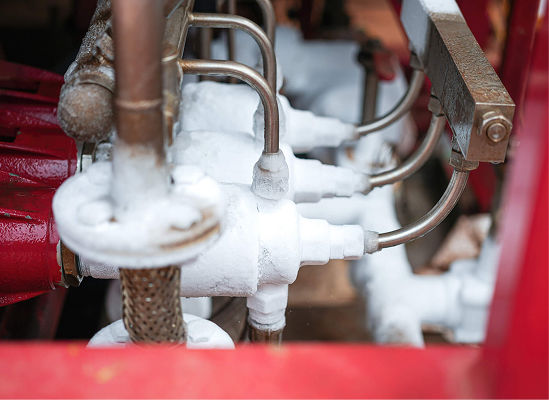
Cryogenic Bellows Seal Conversion
A major industrial and cryogenic gas manufacturer struggled to find a sealing solution for its ACD cryogenic machinery. The original sealing method proved unreliable under the -175°F to -425°F operating conditions. Flexaseal upgraded the construction of the edge-welded bellows seal to accommodate cryogenic temperatures, including a 347 SS core that stays ductile in extreme cold, a tungsten carbide and cryogenic-grade carbon graphite face set that lowers generated heat near volatile materials, and a film-forming additive to support self-lubricated operation.
Higher MTBR, lower maintenance and labor costs, still in service 20+ years later
Read Case StudyFrequently Asked Questions
How do I tell whether a cryogenic seal failed from face wear, bellows fatigue, or an installation problem?
Is some leakage normal in cryogenic service?
What pressures and temperatures are Flexaseal’s cryogenic seals rated for?
Request a Quote
When a cryogenic seal fails, every minute of downtime costs you. Tell us about your application, and we’ll get back to you quickly.
RESPONSE TIME
Quote within 48 hours of receiving your seal with product SDS
REPAIR TURNAROUND
Days, not weeks
WHO YOU REACH
An engineer, not a call center